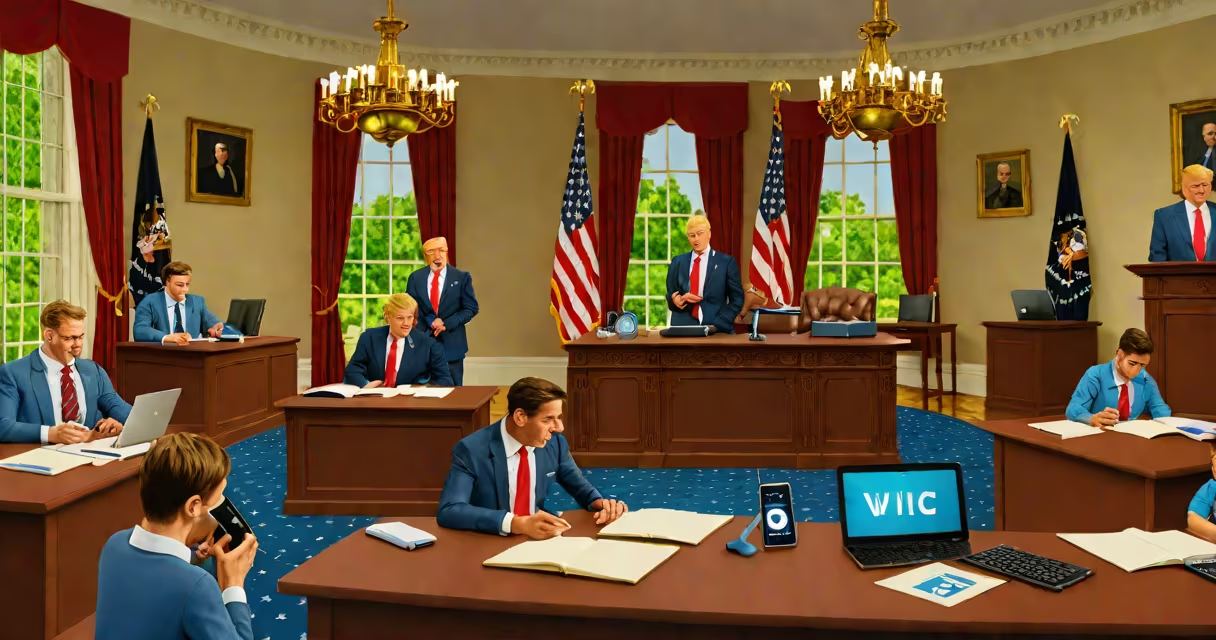
iCivics Win the White House is a free, browser-based educational simulation that lets middle school students experience the process of running for president in the United States. Players take on the role of a candidate, develop campaign platforms, debate opponents, and make policy decisions while going through public opinion, media coverage, and electoral strategy. The game aims to teach civic literacy, political reasoning, and democratic engagement through immersive gameplay.
The simulation models the real mechanics of a U.S. presidential election. Players choose their party, select issues to prioritize, craft speeches, respond to debates, and manage campaign resources. Each decision affects voter sentiment across demographics and regions. The game uses real polling data and historical election patterns to simulate outcomes, offering feedback based on policy choices and messaging effectiveness. It's not a quiz or flashcard tool-it's a changing environment where consequences unfold over time.
Developed by Justice Sandra Day O'Connor, founder of iCivics, the game aligns with national social studies standards. It's used in over 60,000 classrooms across the U.S., according to iCivics' 2023 annual report. Teachers assign it as a unit on elections, government structure, and civic participation. Students don't just learn facts-they practice decision-making under pressure, much like real candidates do during campaigns.
Players begin by selecting a state, party affiliation, and personal platform. They then enter a series of campaign events: town halls, debates, media interviews, and fundraising drives. Each event presents choices with immediate and long-term effects. For example, choosing to support universal healthcare may boost approval among urban voters but reduce support in rural districts.
After each event, the game updates a dashboard showing shifts in polling numbers, donor contributions, and media coverage. Players must balance competing interests-appealing to swing states while maintaining base loyalty. If a candidate's approval drops below 30%, they face a "drop-out" scenario where they must decide whether to continue or exit the race.
A key feature is the "Issue Matrix," which displays how different demographic groups respond to specific policies. A player advocating for climate action sees stronger support from younger voters and coastal populations but weaker backing from industrial regions. This mirrors real electoral dynamics and helps students understand trade-offs in governance.
While the core format remains consistent, iCivics Win the White House offers three distinct modes tailored to different learning goals:
| Mode | Focus Area | Duration | Learning Objective |
|---|---|---|---|
| Standard Campaign | Election strategy and issue prioritization | 12-15 class periods | Understand how platforms influence voter behavior |
| Debate Challenge | Argumentation and rhetoric | 3-5 class periods | Practice persuasive communication under time constraints |
| Policy Simulator | Long-term governance impact | 18-20 class periods | Model how policy decisions affect economic and social indicators |
Each mode includes embedded assessments. After completing a campaign, students submit a reflection essay analyzing their strategy, the most challenging decision they faced, and how their choices affected public perception. These essays are scored using rubrics aligned with Common Core State Standards for writing and social studies.
One non-obvious feature is the "Media Myth" mechanic. During certain events, players receive false or misleading headlines based on real-world misinformation patterns. Responding to these requires critical thinking-students must choose whether to correct the record, ignore it, or pivot messaging. This simulates the challenges of managing narratives in a polarized media field.
Many assume iCivics Win the White House is a video game with winners and losers. It's not. There is no single "correct" path to victory. Success is measured by student engagement, strategic depth, and understanding of democratic processes-not by winning the simulated election. In fact, the game often ends with a candidate losing, prompting reflection on why that happened.
Another misconception is that the game simplifies complex politics. On the contrary, it introduces nuance. For example, a player supporting gun control may see increased support in cities but backlash from rural areas. The game doesn't label policies as "good" or "bad"-it shows how context shapes outcomes. This reflects the National Council for the Social Studies' emphasis on teaching students to analyze multiple perspectives.
Some educators think the game is only for advanced students. But iCivics reports that 78% of middle school teachers using it have students in grades 6-8. The interface is intuitive, with tooltips, audio narration, and progress tracking. A 2022 study by the University of Michigan found that students who played the game scored 22% higher on post-unit assessments of civic knowledge compared to peers who learned via lectures alone.
In my experience teaching 7th grade social studies, I assigned iCivics Win the White House during our unit on elections. One student chose to run as a Green Party candidate focused on climate justice. He spent weeks refining his platform, researching renewable energy policies, and practicing debate responses. After losing the simulation, he wrote, "I didn't expect my environmental plan to hurt me in the Midwest. Now I get why some people feel left out." That insight came from experiencing, not just reading, the trade-offs of policy.
Another class completed the Policy Simulator mode. Students tracked inflation, unemployment, and public trust metrics over four simulated years. One group implemented a universal basic income pilot. While approval rose initially, inflation spiked in the second year. They had to adjust course mid-campaign-a lesson in unintended consequences that textbooks rarely capture.
Teachers can access detailed analytics through the iCivics educator portal. Data includes average time spent per activity, common decision points where students struggle, and performance by demographic group. This allows for targeted instruction. For example, if many students consistently misjudge swing state voting patterns, the teacher can reinforce regional differences in the curriculum.
For those interested in the physical roots of American democracy, the architect who designed the White House shaped a building that embodies the separation of powers-its layout separates legislative, executive, and judicial functions. That same spirit of institutional design lives in iCivics Win the White House: it turns abstract ideas into tangible choices.
ICivics Win the White House isn't about winning. It's about understanding how democracy functions when citizens engage with real decisions. The game gives students a safe space to experiment, fail, reflect, and grow. It transforms passive learners into active participants in civic life.