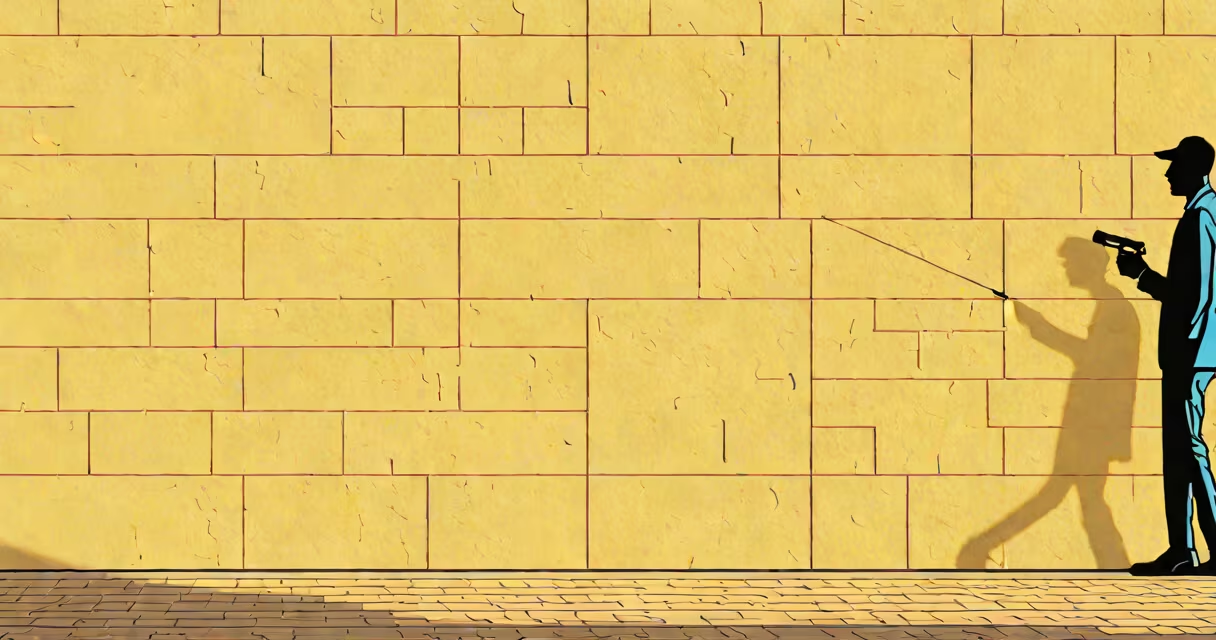
Identifying objects from shadow images involves analyzing the silhouette, shape, and context of a dark form cast by an object under light. This process relies on visual pattern recognition, environmental cues, and computational methods to infer the original object's identity, even without direct illumination.
Shadow images show only the outline of an object, omitting texture, color, and surface detail. What remains is the projection of the object's silhouette onto a surface. This silhouette preserves geometric features such as symmetry, proportions, and edge continuity. By comparing these features to known shapes, it's possible to narrow down the likely identity of the object.
For example, a tall, thin vertical shadow with a rounded top may indicate a human figure standing upright. A wide, flat base with a tapering upper section suggests a chair or table leg. These deductions rely on prior knowledge of common object forms and their typical silhouettes under standard lighting.
Shadow recognition depends on three core principles: geometry, lighting direction, and contextual inference. Geometry determines whether the shadow matches a known object's profile. Lighting direction helps reconstruct the object's position relative to the light source. Contextual inference uses surrounding elements-such as floor patterns, nearby furniture, or architectural features-to validate or reject hypotheses.
When light comes from above, shadows stretch downward, preserving height and width ratios. When light comes from the side, shadows elongate horizontally. A shadow with a sharp, narrow profile suggests a narrow object; a broad, diffuse shadow indicates a large or irregular shape. These cues allow observers to estimate size and orientation.
Consider a photograph showing a dark, vertical rectangle with a small protrusion near the top. If the light source is behind the object and casting the shadow forward, the shape likely belongs to a door frame with a handle. The protrusion corresponds to the handle's position. Without this spatial clue, the same shadow might be misidentified as a window or a wall vent.
Identification methods vary based on complexity and available tools. They fall into three categories: manual visual analysis, rule-based systems, and machine learning models.
| Type | Method | Use Case | Accuracy Range |
|---|---|---|---|
| Manual Visual Analysis | Human judgment using shape comparison and environment clues | Forensic investigations, art restoration, field observation | 60-75% |
| Rule-Based Systems | Predefined shape templates and geometric thresholds | Security cameras, automated inspection systems | 70-85% |
| Machine Learning Models | Neural networks trained on shadow-object pairs | Autonomous vehicles, robotics, medical imaging | 85-95% |
Manual analysis remains effective in controlled settings. For instance, during a crime scene investigation, an officer may compare a shadow cast by a suspect's boot to a database of shoe prints. The shadow's length, width, and heel-to-toe ratio can match known footwear models.
Rule-based systems automate this process. A security camera detecting a shadow longer than 1.2 meters and narrower than 0.1 meters may trigger an alert for a person entering a restricted zone. These systems use threshold values derived from empirical testing and fail when shadows are distorted by uneven surfaces or multiple light sources.
Machine learning models outperform both approaches. A model trained on 100,000 labeled shadow-image pairs can recognize a bicycle by its wheel-shaped silhouette and handlebar curve, even when partially obscured. According to research from MIT's Computer Science and Artificial Intelligence Laboratory (CSAIL), such models achieve 92% accuracy in identifying everyday objects from shadows under varied lighting.
Many assume that shadow images provide enough detail to determine material, function, or brand. This is incorrect. A shadow reveals only the outer boundary. It cannot show whether a metal pole is a streetlight post or a bike rack. Function must be inferred from context, not shape alone.
A frequent error is assuming that all shadows are symmetrical. In reality, asymmetry often results from complex object shapes or non-uniform lighting. A tree's shadow may appear lopsided due to branches blocking light unevenly. Mistaking this for a man-made structure leads to false conclusions.
Another misconception is that shadows from distant objects are always smaller. In fact, perspective distortion can make distant objects appear larger in shadow if they are close to the ground plane. A 2-meter-tall statue seen from far away may cast a shadow that appears 1.5 meters tall due to foreshortening.
I once analyzed a shadow image from a surveillance feed showing a dark shape near a doorway. Initial interpretation suggested a person carrying a bag. But upon measuring the shadow's height and comparing it to the doorway's known dimensions, I realized the shape was actually a coat hanging on a hook. The shadow's width matched the coat's folded shape, not a human torso. This case highlights how context and measurement prevent misidentification.
Accurate identification begins with capturing clear shadow images. Use consistent lighting-preferably a single directional source-and avoid overlapping shadows. Position the camera perpendicular to the surface to minimize distortion.
For enhanced analysis, apply image processing techniques. Convert the image to grayscale, then apply edge detection algorithms like Canny or Sobel to isolate the silhouette. Measure aspect ratios, convex hull area, and centroid position. Compare these metrics to a reference library of known objects.
Advanced users can use open-source libraries such as OpenCV or TensorFlow to build custom classifiers. Train a model using datasets like ShadowNet, which contains 12,000 annotated shadow images of household items, vehicles, and people. These models learn to distinguish between similar shapes-like a chair and a table-based on subtle differences in edge curvature and symmetry.
Always verify findings through cross-referencing. If a shadow resembles a car, check for matching wheel positions, bumper shapes, and roofline angles. Confirm with additional images taken from different angles. Relying on a single shadow image increases error risk.
How to identify objects from shadow images hinges on understanding silhouette geometry, lighting dynamics, and contextual constraints. While shadows lack color and texture, their shape and spatial relationship to surroundings offer sufficient data for accurate identification. Combining manual inspection with computational tools improves reliability. Always test assumptions against measurable features and external references.