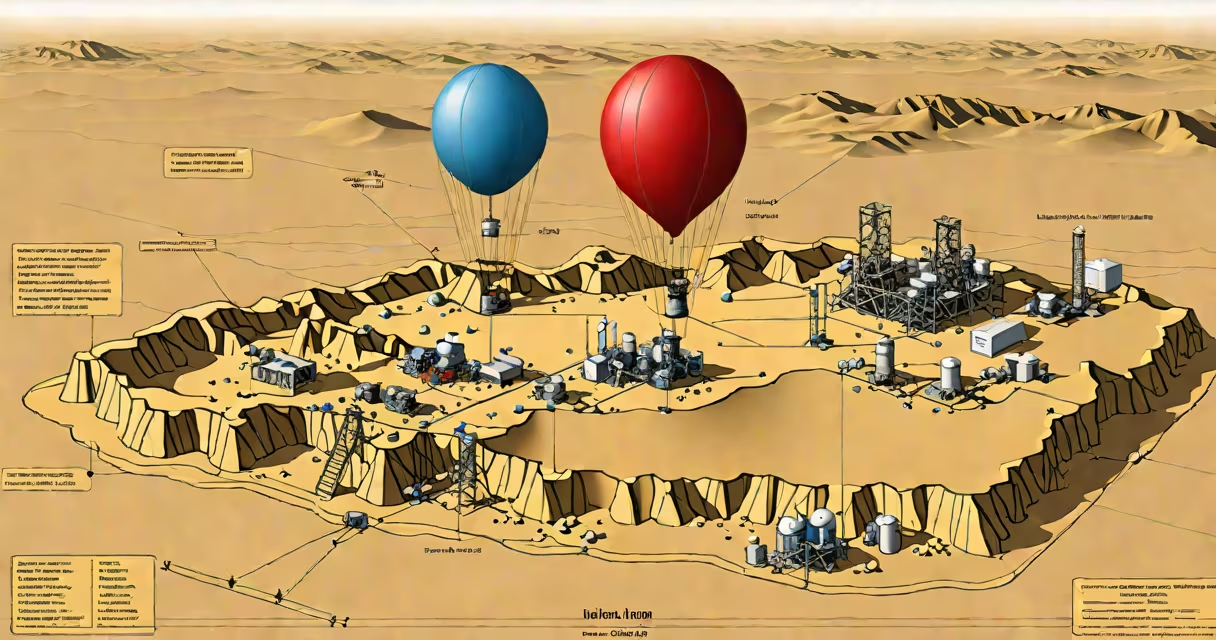
Helium originates deep underground, formed over millions of years as alpha particles from uranium and thorium decay escape and combine into helium atoms. These atoms accumulate in natural gas reservoirs, where they are extracted during gas processing. Helium is not produced industrially-it's a byproduct of fossil fuel extraction.
Most helium on Earth comes from the slow decay of radioactive elements in Earth's crust. Uranium-238 and thorium-232 release alpha particles-helium nuclei-that gain electrons over time to become stable helium-4 atoms. This process takes hundreds of thousands to millions of years. Once formed, helium migrates upward through porous rock until trapped in subsurface gas pockets, often alongside methane and other hydrocarbons.
The U.S. National Science Foundation notes that helium is the second-lightest element and the second-most abundant in the universe, but on Earth it's rare because it escapes into space due to low density and high thermal velocity. Only about 0.0005% of Earth's atmosphere is helium, and most of that is lost to space. The small fraction that remains is trapped in geologic formations, making it a finite resource.
Commercial helium is recovered from natural gas fields where concentrations exceed 0.3%. The largest known deposits are in the United States, particularly in the Texas Panhandle, Kansas, and Oklahoma. The Federal Helium Reserve in Amarillo, Texas, holds the world's largest known reserve, established in 1925 to ensure military and scientific access during wartime.
Extraction begins when natural gas is pumped from underground. The gas mixture is cooled to cryogenic temperatures, separating helium from heavier gases. Helium's boiling point is −268.9°C, far lower than nitrogen (−195.8°C) or methane (−161.5°C), allowing precise separation via fractional distillation. After purification, helium is stored as a liquid under pressure in insulated tanks.
Global production is dominated by the U.S., Qatar, Russia, and Algeria. The U.S. supplies about 40% of the world's helium, though its share has declined since the 2010s due to depletion of the federal reserve. In 2023, the U.S. produced 11.5 billion cubic feet of helium, according to the U.S. Energy Information Administration (EIA).
| Country | Estimated Annual Production (billion ft³) | Primary Source |
|---|---|---|
| United States | 11.5 | Natural gas fields in Texas, Kansas |
| Qatar | 7.2 | North Field gas reservoir |
| Russia | 5.1 | Siberian gas fields |
| Algeria | 3.8 | South Algerian basins |
Not all natural gas contains usable helium. Gas from shale formations typically has less than 0.1%, making it uneconomical to extract. High-grade helium requires specific geologic conditions: ancient, porous rock layers with impermeable caps to trap rising gas. The presence of uranium-rich sedimentary rocks increases the likelihood of helium accumulation.
Unlike renewable resources, helium cannot be recycled efficiently. Most helium is released into the atmosphere after use in medical imaging, welding, or party balloons. Once released, it diffuses into space and is gone forever. The International Atomic Energy Agency (IAEA) estimates that over 90% of helium used globally is lost to the atmosphere.
Recovery from air is theoretically possible but impractical. Air contains only 5.2 parts per million of helium. To isolate one liter of helium from air requires processing over 19,000 liters of air-a process that consumes more energy than the value of the helium recovered. Industrial-scale recovery from air is not economically viable.
A common misconception is that helium is mined like a mineral. It's not. It's extracted as a component of natural gas. When natural gas is drilled, helium is captured during processing. If the gas field has low helium concentration, the gas is sold as fuel, and helium is left behind. This makes helium supply vulnerable to fluctuations in oil and gas demand.
Many assume helium is manufactured or synthesized. It is not. All terrestrial helium is derived from radioactive decay. The idea that helium is "produced" in labs or factories is false. Even in nuclear fusion experiments, helium is a product-not a raw material.
Another myth is that helium is abundant on Earth. While it's the second most common element in the universe, it's extremely scarce on Earth. Only about 200 million cubic meters of recoverable helium exist worldwide. At current consumption rates, the global supply could last 50 to 70 years, depending on new discoveries and recycling efforts.
I once observed a helium extraction plant in Wyoming during a field visit. The facility processed gas from a well with 0.4% helium. The team used a series of cryogenic columns to cool the gas stream. They measured helium purity using mass spectrometry-each sample had to exceed 99.99% purity before being liquefied and stored. The entire process took 12 hours per batch, and even then, only 30% of the incoming gas was helium.
As demand grows-especially in quantum computing, MRI machines, and aerospace-efforts to improve recovery efficiency are increasing. Some researchers are exploring helium recovery from industrial off-gases, such as those in ammonia production. A pilot project in Germany recovers 15% of helium from waste streams, though scaling remains challenging.
Recycling helium is gaining traction. Hospitals using MRI scanners now install closed-loop systems that capture and reuse helium. The University of California, Berkeley, reported a 40% reduction in helium use per scan after retrofitting equipment with recycling units. Still, widespread adoption is limited by cost and infrastructure.
For long-term sustainability, scientists are investigating helium extraction from lunar regolith. The Moon's surface contains trace amounts of helium-3, a rare isotope formed by solar wind. While not directly usable for Earth applications, research into lunar mining continues. NASA's Artemis program includes plans to test in-situ resource utilization, including helium extraction, by 2030.