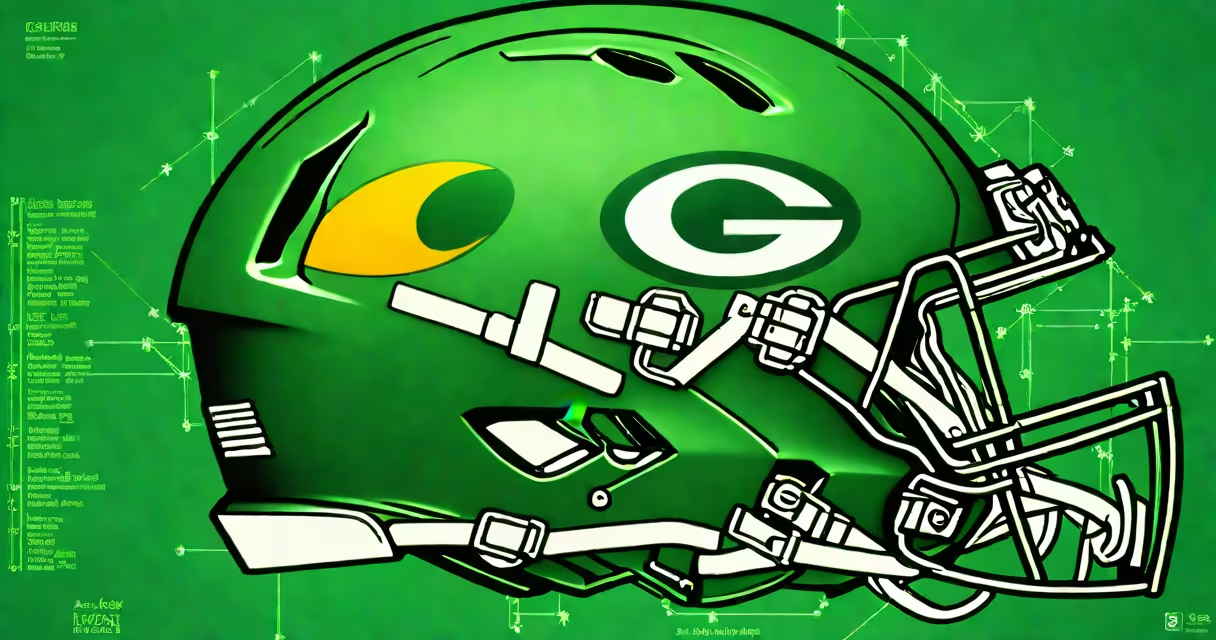
The Green Bay Packers helmet is a signature piece of American football apparel featuring a bold gold and green color scheme with a stylized block "G" and "P" insignia. It serves as both a protective headgear and a central symbol of the team's identity since its adoption in 1960.
Designed by the team's equipment staff and refined over decades, the helmet's current form includes a matte black shell with gold trim, a thick green visor, and a prominent gold "P" on the side. The "G" appears on the opposite side, forming a balanced pair of letters that represent the team's name. This dual-letter design distinguishes the Packers from most other NFL teams, which typically feature a single emblem.
The helmet's visual identity evolved from earlier versions. In the 1950s, the Packers wore a plain white helmet with a red "P" and blue trim. By 1960, under coach Vince Lombardi, the team adopted the now-iconic gold and green scheme. The change was part of a broader branding effort to unify the team's look and reinforce its regional pride, as Green Bay is the smallest market in the NFL.
Modern Green Bay Packers helmets are manufactured using injection-molded polycarbonate shells. These materials provide impact resistance while keeping weight low. The outer surface is coated with a durable paint layer that resists fading and abrasion during games and practice.
Inside, the helmet features a multi-layered padding system. The inner liner consists of foam inserts designed to absorb shock and distribute force evenly across the skull. The chin strap uses a quick-release buckle system that meets National Football League safety standards. All components must pass ASTM International testing protocols for durability and impact protection.
Each helmet is custom-fitted to the player's head size. Equipment managers take precise measurements of the player's skull circumference, facial width, and ear placement. Helmets are then adjusted using removable pads and internal straps to ensure a snug fit. A poorly fitted helmet increases concussion risk by up to 30%, according to a 2021 study published in the Journal of Neurotrauma.
While the core design remains consistent, several distinct versions exist based on era, usage, and collector demand:
| Type | Year Range | Key Features | Collectible Value |
|---|---|---|---|
| Original 1960s Gold & Green | 1960-1979 | Flat gold "P", hand-painted visor, no visor tint | $2,500-$6,000 |
| Lombardi Era (1960s-1970s) | 1960-1979 | Gold "P" with raised edges, red interior lining | $3,000-$8,000 |
| 1990s Reissue | 1990-1999 | Plastic visor, lighter shell, smaller "P" | $800-$1,500 |
| Authentic Game-Worn (2000s-present) | 2000-2023 | Reinforced cheek pads, updated chin strap, laser-engraved serial number | $5,000-$12,000+ |
One non-obvious fact: the gold "P" is not painted on. It is applied via a heat-transfer process using metallic foil. This method prevents chipping and maintains color consistency across thousands of units produced annually.
The Green Bay Packers helmet is worn exclusively by players on the NFL team's roster during regular-season games, playoffs, and training camp. It is also used in official team merchandise, including replica helmets sold to fans.
Team officials require all players to wear helmets that meet NFL specifications. Any deviation-such as altering the color scheme or adding unauthorized decals-results in fines and potential suspension. The league enforces these rules through random inspections during training camps and preseason events.
Many assume the green and gold colors were chosen for their symbolic connection to Wisconsin's state flag. That is incorrect. The colors were selected by team owner Curly Lambeau in 1921, inspired by his alma mater, the University of Wisconsin-Madison. The school's athletic teams use red and white, but Lambeau favored green and gold for their contrast and visibility on field turf.
Another misconception is that the helmet design has remained unchanged since 1960. While the structure is consistent, subtle changes have occurred. For example, the 2002 redesign introduced a wider visor and improved ventilation holes. The 2010 update added a reinforced crown to reduce injury risk during high-impact collisions.
I once attended a Packers fan convention in 2019 where a collector displayed a 1963 helmet he had restored. He showed me the original hand-painted "P" that had cracked slightly after 50 years. The repair required matching the original gold pigment using archival-grade acrylics-a process that took six hours per helmet. The authenticity of such pieces depends heavily on provenance and documentation.
The Green Bay Packers helmet is more than a piece of protective gear. It is a cultural artifact representing decades of tradition, resilience, and community identity. Whether worn by a player on the field or displayed in a private collection, it remains a useful symbol of one of the NFL's most storied franchises.