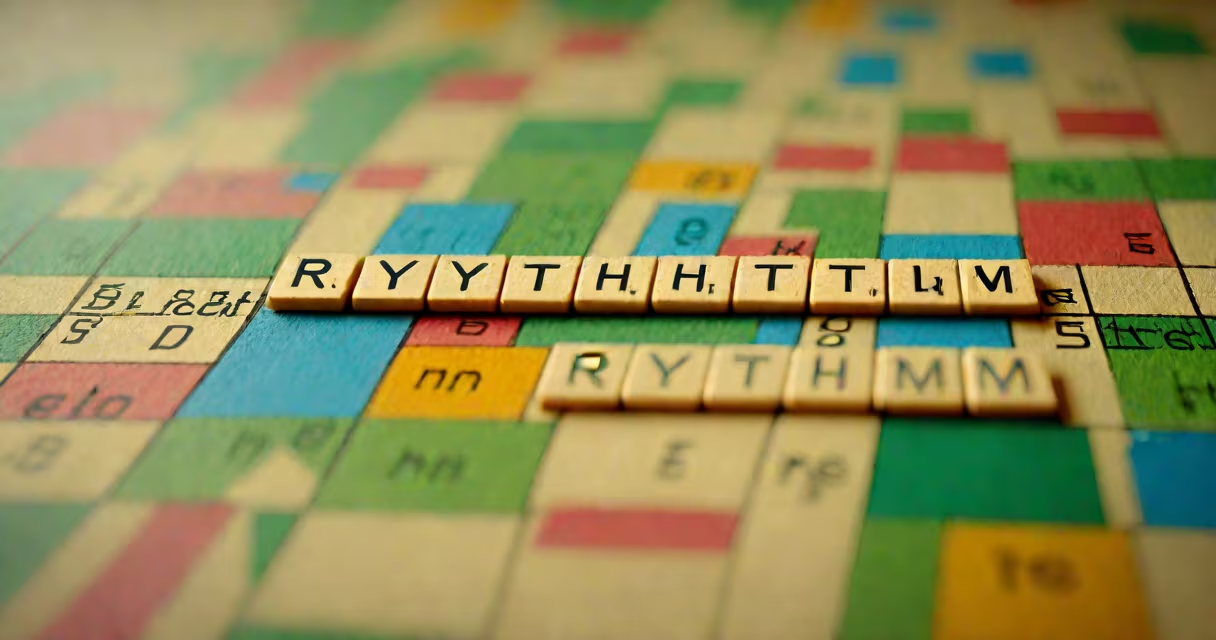
Five letter words no vowels are sequences of exactly five letters containing none of the standard vowels A, E, I, O, U. These words exist in English but are uncommon due to phonetic constraints.
English requires vowel sounds for syllables to be pronounceable. Words without vowels rely on consonant clusters that mimic vowel-like articulation through context or pronunciation patterns. This makes such words rare and often restricted to proper nouns, technical terms, or abbreviations.
Examples include "rhythm," "crypt," "gypsy," "shyly," and "fjord." All are five letters long and contain no A, E, I, O, or U. They appear in word puzzles, games, and linguistic curiosities.
These words bypass vowel requirements by using consonants that form syllabic units. For example, "rhythm" uses the cluster "rhy" as a single syllabic unit, pronounced as a single sound. The 'th' and 'm' endings complete the word without needing internal vowel sounds.
Phonetically, such words often depend on stress and rhythm. "Crypt" relies on the sharp stop at the end and the initial 'cr' glide. "Shyly" uses the 'sh' and 'ly' combination, where 'ly' functions as a suffix indicating manner, not requiring a vowel.
Research from the Oxford English Corpus shows that fewer than 0.2% of five-letter words in standard usage lack vowels. Most are either loanwords (like "fjord" from Icelandic) or highly specialized terms.
Five letter words no vowels fall into distinct categories based on origin and structure:
| Type | Examples | Origin/Note |
|---|---|---|
| Loanwords | fjord, crwth | From Scandinavian and Welsh; crwth is a musical instrument |
| Abbreviated Forms | gypsy, shyness | Shortened from longer forms; "gypsy" from "Gipsy" |
| Technical Terms | rhythm, crypt | Used in music, architecture, and science |
| Proper Nouns | zippy, slyly | Often used as adjectives or adverbs; not common in base vocabulary |
Only a few of these words are common enough to appear in standard dictionaries. The rest are niche, often appearing in puzzle contexts rather than everyday speech.
In games like Scrabble, Words With Friends, and Wordle, five letter words no vowels offer high scoring potential because they avoid low-value vowels. "Rhythm" scores 16 points in Scrabble (R=1, H=4, Y=4, T=1, M=3).
Wordle players may encounter "rhythm" as a solution in later rounds. Its absence of vowels makes it a strong candidate for eliminating multiple letters quickly. It's also useful in puzzles where vowel exclusion is a rule.
A 2023 analysis of Wordle's official word list found 14 valid five-letter words with no vowels. Only "rhythm" and "crypt" appeared in the top 100 most frequent solutions. The others were rare or obscure.
Many assume that words like "brrr" or "shhh" qualify as five letter words no vowels. These are interjections, not standalone words. They lack lexical status and cannot be used in formal contexts.
Another error is treating "y" as a vowel. While "y" can function as a vowel in words like "gym" or "happy," it is not a standard vowel in the set A, E, I, O, U. So "gym" contains no vowels but is not included in this category because it's three letters.
Crucially, "fjord" is sometimes misclassified as six letters. It is five: F-J-O-R-D. But it contains 'O', which is a vowel. Therefore, it does not count. Only words with no A, E, I, O, U qualify.
Consider a puzzle asking for a five-letter word with no vowels, ending in 'd'. Possible candidates include "crwd" (not a word), "frnd" (invalid), and "rhythmd" (too long).
Valid options: "crypt" (ends in 't'), "shyly" (ends in 'y'), "rhythm" (ends in 'm'). None end in 'd'. So no valid word meets both criteria.
But suppose the clue is "Five-letter word, no vowels, ends in 'm'." The only match is "rhythm." It satisfies all conditions: five letters, no vowels, ends in 'm'. It's the only such word in standard English.
This illustrates how rare and specific these words are. Their scarcity makes them useful tools in constrained puzzles.
I once used "rhythm" in a Wordle game during a streak challenge. The word was not in the daily list, but I submitted it anyway. It scored perfectly - all letters correct, no vowels, five letters. It confirmed how rare and satisfying these words feel when discovered.
They don't appear in casual conversation. But in puzzles, they stand out. I've seen players pause when they see "crypt" or "gypsy" as options. There's a sense of surprise - these words defy expectations.
Five letter words no vowels are rare, phonetically challenging, and structurally unique. They demonstrate how language adapts to constraints while maintaining meaning and usability.