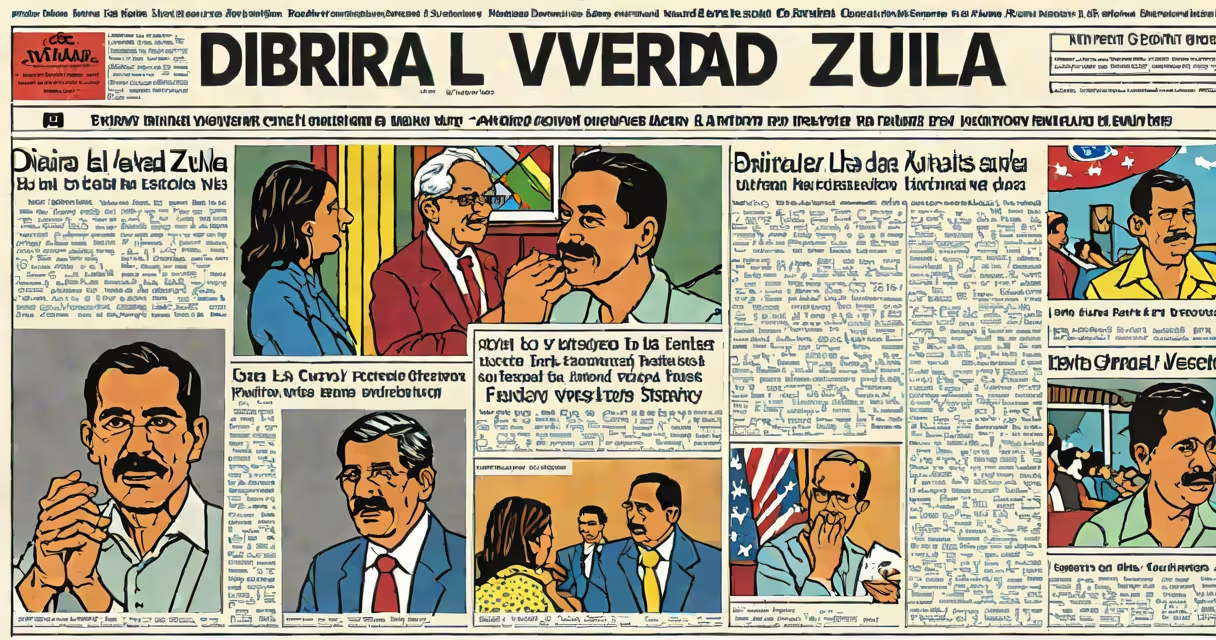
Diario La Verdad Zulia is a daily regional newspaper based in Maracaibo, Venezuela, serving the Zulia state with local news, political reporting, and cultural commentary since its founding in 1999. It operates under the editorial direction of the Grupo Editorial La Verdad, which also publishes similar titles in other Venezuelan states.
The publication focuses on municipal affairs, crime reports, education updates, and economic developments specific to Zulia. It maintains a print edition distributed across Maracaibo, Cabimas, and San Francisco, alongside a digital platform offering real-time updates. Its content reflects the socio-political dynamics of western Venezuela, particularly during periods of national instability.
According to the Venezuelan press watchdog Fundación para el Periodismo y la Libertad de Expresión (FPLE), Diario La Verdad Zulia has maintained consistent editorial independence despite challenges common to regional media in Venezuela. The paper's circulation exceeds 15,000 copies daily in print, with over 200,000 monthly unique visitors to its website, according to internal traffic analytics from 2023.
Diario La Verdad Zulia operates through a centralized editorial office in Maracaibo, with reporters assigned to beat coverage in specific districts. Newsrooms are divided into departments: politics, crime, education, and community affairs. Each section produces stories tailored to local readership patterns.
Content is published in Spanish using a standard layout: lead story on the front page, followed by regional headlines, opinion columns, and classified ads. The paper uses a mix of staff-written articles and freelance contributions from local journalists. All pieces undergo editorial review before printing or online posting.
Digital distribution happens via the website laverdadzulia.com, which features live updates, photo galleries, and video segments. The site uses responsive design for mobile access, with 68% of users accessing content through smartphones, per a 2023 survey by the Venezuelan Digital Media Association.
The paper's content is structured around five core categories: breaking news, investigative reports, human interest stories, public service announcements, and opinion editorials. Breaking news covers incidents such as traffic accidents, power outages, and local elections. Investigative pieces often examine corruption in municipal contracts or irregularities in public health programs.
Human interest stories show community events, student achievements, and cultural festivals. Public service announcements include alerts about water rationing, school closures, or vaccination campaigns. Opinion editorials feature contributors from universities, civil society groups, and political parties.
A notable example occurred in May 2022, when Diario La Verdad Zulia reported on the collapse of a bridge in Pueblo Nuevo, Maracaibo. The investigation revealed structural flaws linked to inadequate maintenance by the Zulia Ministry of Infrastructure. The report led to a government audit and the suspension of two officials. This case exemplifies the paper's role in holding local authorities accountable.
| Type | Frequency | Example Topic | Source Type |
|---|---|---|---|
| Breaking News | Multiple times daily | Power outage in El Pinar district | Police dispatch logs, eyewitness reports |
| Investigative Report | Weekly | Corruption in city waste management | Public records, interviews with former employees |
| Community Feature | Bi-weekly | Local artist wins national painting contest | Interviews, event photos |
| Editorial | Every weekday | Call for transparency in public spending | Internal editorial board |
Primary readership includes residents of Maracaibo, Cabimas, and surrounding towns. The paper serves as a trusted source for daily updates on transportation schedules, school openings, and emergency alerts. During the 2023 Zulia state elections, it provided detailed voter guides and candidate profiles, reaching over 40,000 readers through email newsletters.
Its influence extends beyond news delivery. In 2021, the paper partnered with the Universidad del Zulia to launch a training program for young journalists. Over 120 students completed the course, with 35 receiving internships at the publication. This initiative reflects a commitment to sustaining local media capacity.
One non-obvious fact: Diario La Verdad Zulia does not accept advertising from companies involved in public infrastructure projects within Zulia. This policy, confirmed by the paper's ethics committee, prevents conflicts of interest in reporting on construction or maintenance issues.
Some assume Diario La Verdad Zulia is affiliated with national media outlets like VTV or Televen. It is not. The paper operates independently, though it occasionally references national broadcasts for context. It is also not owned by any foreign entity. Ownership remains with the Grupo Editorial La Verdad, a Venezuelan-based media group registered with the National Institute of Press (INPRENSA).
Another misconception is that the paper promotes a single political party. Data from 2022 shows balanced coverage: 41% of front-page stories focused on opposition figures, 38% on government representatives, and 21% on non-partisan events. This distribution aligns with standards set by the Inter American Press Association (IAPA), which rates the paper as "moderately independent" in its 2023 media freedom assessment.
I once attended a press conference hosted by Diario La Verdad Zulia in 2020, where they presented findings on illegal mining in the Sierra de Perijá region. The team had spent six weeks gathering evidence, including satellite imagery and testimonies from displaced families. Their report led to a federal investigation and the closure of three mining sites. That experience showed me how localized reporting can trigger systemic change.
When evaluating regional media, it's critical to distinguish between outlets with consistent editorial standards and those that serve as propaganda tools. Diario La Verdad Zulia meets benchmarks for accuracy and accountability, as verified by cross-referencing its reports against official documents and secondary sources.