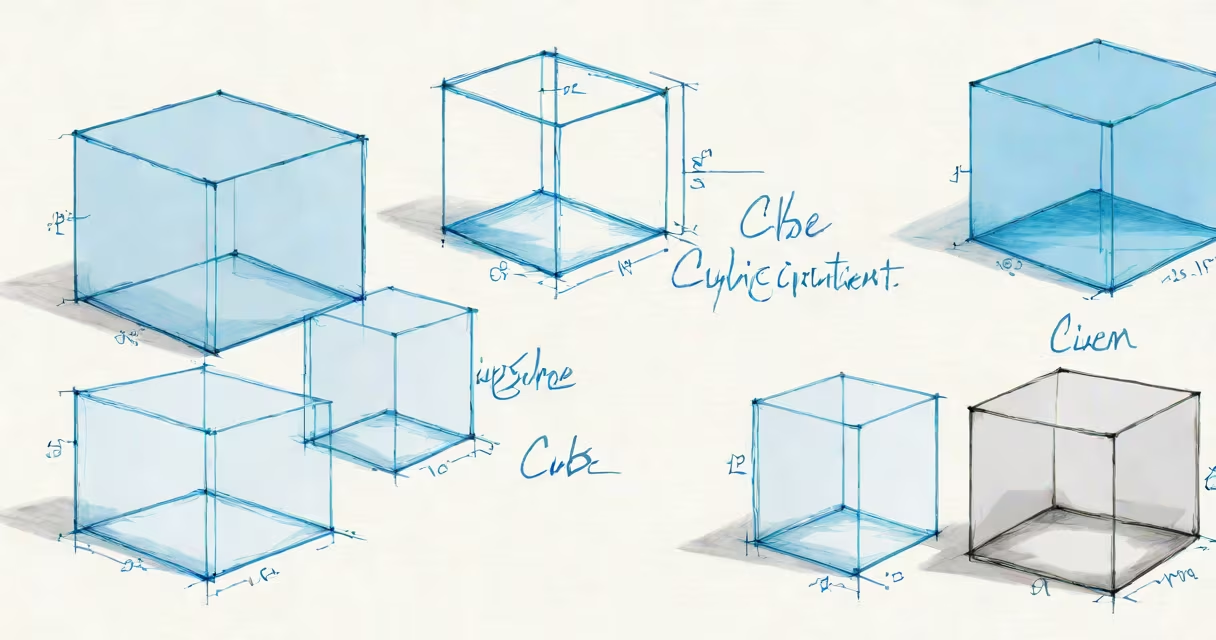
The conversion of cubic centimeter to cubic meter uses a fixed ratio: 1 cubic meter equals 1,000,000 cubic centimeters. This relationship stems from the metric system's base-10 structure, where each linear dimension scales by 100, and volume scales by 100³.
Cubic centimeter (cm³) and cubic meter (m³) are both units of volume in the International System of Units (SI). A cubic centimeter represents the volume of a cube measuring 1 cm on each side. A cubic meter is the volume of a cube measuring 1 meter on each side. Since 1 meter equals 100 centimeters, a cubic meter contains 100 × 100 × 100 = 1,000,000 cubic centimeters.
To convert from cubic centimeters to cubic meters, divide the number of cubic centimeters by 1,000,000. For example, 500,000 cm³ ÷ 1,000,000 = 0.5 m³. This conversion is essential in scientific, engineering, and industrial contexts where precise volume measurements are required.
The metric system is decimal-based, meaning conversions between units involve powers of ten. Volume is derived from length cubed. Because 1 meter = 100 centimeters, the cubic relationship results in 100³ = 1,000,000. This makes the conversion factor consistent and predictable.
Any volume expressed in cubic centimeters can be converted to cubic meters by shifting the decimal point six places to the left. For instance, 2,500,000 cm³ becomes 2.5 m³. Conversely, to convert from cubic meters to cubic centimeters, multiply by 1,000,000. This reversibility ensures accuracy across disciplines.
This conversion is not arbitrary-it follows the SI standard defined by the Bureau International des Poids et Mesures (BIPM). The BIPM confirms that the cubic meter is the coherent derived unit for volume in the SI system, and all other volume units are derived from it through multiplication or division by powers of ten.
Engineers use this conversion when calculating fluid displacement in pipelines. A hydraulic system designed to handle 3,000,000 cm³ of oil requires a reservoir capacity of 3 m³. Without correct unit conversion, equipment may be undersized or oversized, leading to inefficiency or failure.
In environmental science, researchers measure carbon dioxide emissions in cubic meters per year. If a factory emits 12,000,000,000 cm³ of CO₂ annually, that equals 12,000 m³. This allows direct comparison with global emission thresholds set in cubic meters.
A real-world example: a water tank labeled as holding 250,000 cm³ of liquid contains 0.25 m³ of water. This is equivalent to 250 liters-a standard household measurement. The conversion enables accurate communication between technical specifications and everyday understanding.
While cubic centimeter and cubic meter are standard SI units, other volume measures exist. The table below compares common volume units and their relation to cubic meters:
| Unit | Symbol | Equivalent in Cubic Meters | Use Case |
|---|---|---|---|
| Cubic centimeter | cm³ | 1 × 10⁻⁶ m³ | Medical dosages, small lab samples |
| Liter | L | 0.001 m³ | Everyday liquids, fuel volumes |
| Cubic decimeter | dm³ | 0.001 m³ | Industrial packaging, chemistry |
| Cubic kilometer | km³ | 1,000,000,000 m³ | Geological volumes, oceanic storage |
One non-obvious distinction: while 1 liter equals 1 dm³, it also equals 1,000 cm³. This means that 1 m³ = 1,000 liters = 1,000,000 cm³. These equivalences are critical in fields like pharmaceuticals, where dosage precision matters.
Many assume that converting between cubic units is similar to linear conversion-dividing by 100. But volume scales with the cube of linear dimensions. Dividing 100 cm³ by 100 gives 1 cm³, not 1 m³. The error arises from confusing linear, area, and volume scaling.
Another frequent mistake is reversing the conversion. Someone might think 1 m³ = 100 cm³, which is incorrect. The correct inverse is 1 m³ = 1,000,000 cm³. This misunderstanding leads to errors in material estimation, especially in construction or manufacturing.
I once observed a student calculate the volume of a shipping container as 150,000 cm³ instead of 150 m³. The error stemmed from treating cubic centimeters as if they were linear centimeters. Correcting the scale revealed a 1,000-fold underestimation of space needed.
Accurate volume conversion prevents costly mistakes. In chemical manufacturing, a reaction requiring 0.002 m³ of reagent must be measured precisely. Using 2,000 cm³ is correct-but confusing it with 200 cm³ causes a 10-fold dilution, altering the reaction outcome.
International standards require consistency. The National Institute of Standards and Technology (NIST) states that all measurements in scientific research must use SI units unless otherwise specified. Converting cubic centimeters to cubic meters ensures compliance with global standards.
For example, a laboratory reports a sample volume as 450,000 cm³. To meet reporting guidelines, this must be converted to 0.45 m³. Failure to do so risks rejection during peer review or regulatory inspection.
When working with large-scale systems-such as water treatment plants or gas storage facilities-the difference between cubic meters and cubic centimeters is not just numerical. It affects safety, efficiency, and cost. A pipeline rated for 10,000 m³ of flow cannot be sized based on 10,000,000,000 cm³ without proper conversion.
To convert any value from cubic centimeters to cubic meters, apply the formula:
m³ = cm³ ÷ 1,000,000.
As a final example: a 3D-printed component has a volume of 1,250,000 cm³. Divide by 1,000,000: 1,250,000 ÷ 1,000,000 = 1.25 m³. The result is 1.25 cubic meters.
Understanding the conversion of cubic centimeter to cubic meter is foundational for anyone working with physical quantities. It ensures clarity across disciplines-from medicine to aerospace-and supports accurate communication in a globally standardized system.
For further calculations involving volume and mass, converting cubic meters to tons is a necessary next step in logistics and materials planning.