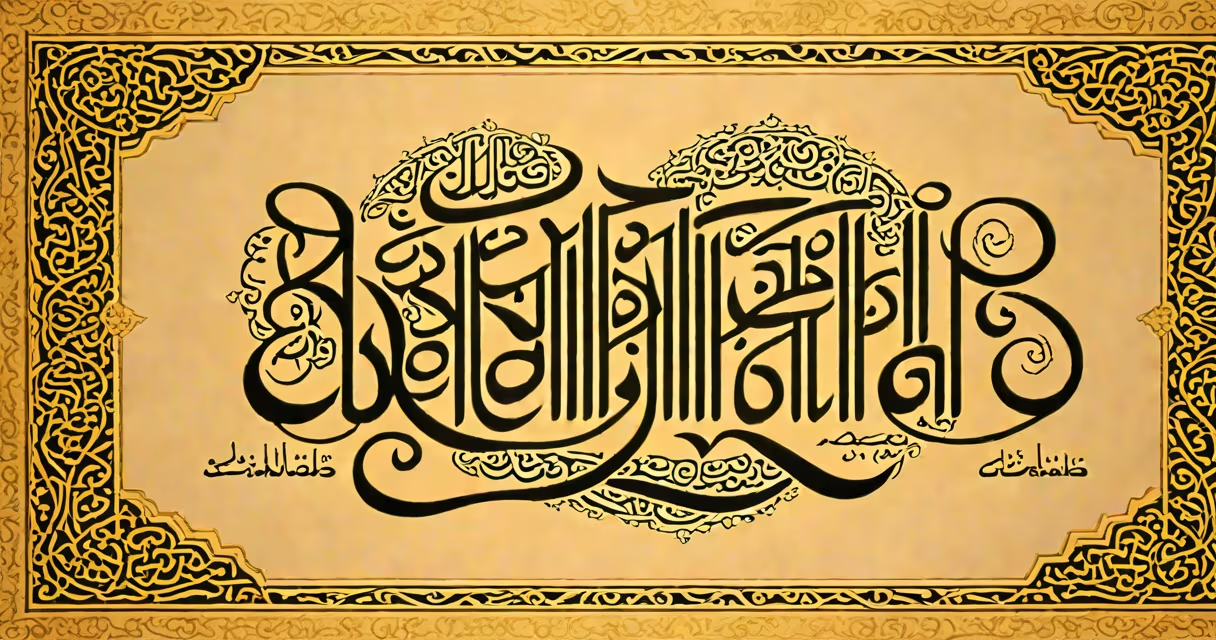
The phrase bismillah rahman rahim translates to "In the name of Allah, the Most Gracious, the Most Merciful." It is the opening invocation of every chapter in the Quran except Surah Al-Tawbah, and serves as a spiritual and ritual foundation in Islamic tradition.
This phrase appears at the beginning of nearly all formal Islamic actions-prayer, eating, writing, and decision-making. It marks the start of sacred acts with divine acknowledgment. The term bismillah means "in the name of," while ar-Rahman and ar-Rahim are two of the 99 names of Allah, emphasizing boundless mercy and compassion.
According to the Qur'an, Allah says in Surah Al-Fatiha (1:1): "Al-hamdulillahi rabb il-'alameen" - "Praise be to Allah, Lord of the worlds." This sets the tone for all religious expression. The inclusion of bismillah rahman rahim at the start of Surah Al-Fatiha reinforces that all worship begins with gratitude and recognition of divine grace.
In daily life, Muslims recite bismillah rahman rahim before starting meals, prayers, or any significant task. This act is not ceremonial-it's a conscious affirmation of dependence on God's mercy. The Prophet Muhammad (peace be upon him) emphasized this in a hadith recorded in Sahih al-Bukhari: "When any of you eats, let him say 'Bismillah,' and if he forgets to say it at the beginning, let him say 'Bismillah' at the end."
Even in legal and administrative contexts, the phrase holds weight. In Islamic finance, contracts begin with bismillah to affirm ethical intent. In academic writing, scholars often open papers with the phrase to invoke clarity and integrity.
A practical example: A student preparing for an exam says bismillah rahman rahim aloud before opening their book. This is not superstition-it's a psychological and spiritual reset. Research from the University of California, San Diego, shows that ritualized beginnings reduce anxiety and improve focus, aligning with Islamic teachings on mindfulness.
The phrase consists of four core elements:
While both terms describe mercy, ar-Rahman implies broad, encompassing grace, whereas ar-Rahim points to targeted, responsive compassion. This distinction is important in understanding the layered nature of divine attributes.
Some translations render the full phrase as "In the name of Allah, the Beneficent, the Merciful," using older English forms. However, modern scholarly consensus favors "Most Gracious, Most Merciful" for accuracy and consistency with classical tafsir (exegesis).
For example, the translation by Dr. Muhammad Muhsin Khan and Dr. Muhammad Taqi-ud-Din al-Hilali in the English Translation of the Holy Qur'an states: "In the name of Allah, the Most Gracious, the Most Merciful." This version is endorsed by the Islamic Fiqh Council of the Muslim World League.
Many assume bismillah rahman rahim is only for religious rituals. But it's used in secular contexts too. In Turkey, public schools begin each day with the phrase. In Indonesia, government documents often open with it.
Another misconception: that saying it once suffices. In reality, it's meant to be internalized. The Prophet Muhammad (peace be upon him) said, "Whoever says 'Bismillah' at the beginning of his work, Allah will bless it." This suggests ongoing intentionality, not just mechanical repetition.
Also, bismillah is not a magic incantation. It's a declaration of purpose. Saying it before surgery, study, or travel is not about changing outcomes-it's about aligning one's heart with divine guidance.
A personal observation: During a visit to a mosque in Istanbul, I watched a group of children learning to write Arabic. Each time they began a new line, they whispered bismillah rahman rahim. Not because they were told to, but because they understood it as a way to honor the act of creation itself.
Though most associated with the Quran, bismillah rahman rahim appears in other texts. It opens the first verse of Surah Al-Baqarah (2:1), the longest chapter in the Quran. It also appears in the Shahada-the Islamic declaration of faith-but not in the exact form. The Shahada says: "La ilaha illa Allah, Muhammadur rasul Allah," which affirms monotheism and prophethood.
There is no equivalent in Christian or Jewish liturgy. While "In the name of the Father, Son, and Holy Spirit" shares structural similarity, the theological roots differ. In Christianity, the Trinity is central; in Islam, the oneness of God (tawhid) is absolute.
For comparison:
| Feature | Bismillah rahman rahim | Christian Trinitarian Formula |
|---|---|---|
| Language | Arabic | Latin/Greek (original), then vernacular |
| Meaning | In the name of Allah, the Most Gracious, the Most Merciful | In the name of the Father, Son, and Holy Spirit |
| Use | Start of prayer, food, writing, decisions | Baptism, blessing, liturgical rites |
| Divine Attributes | Graciousness and mercy | Unity in three persons |
Unlike the Christian formula, which centers on relational unity, bismillah rahman rahim centers on divine benevolence and the act of beginning with awareness.
Bismillah rahman rahim meaning in English is not just a phrase-it's a structure for living with intention. It reminds the believer that every action, big or small, should begin with recognition of God's mercy. Its presence in scripture, daily practice, and cultural expression underscores its enduring role in Islamic identity.
Understanding this phrase helps clarify why Muslims recite it before meals, prayers, and even when turning on a light. It's not ritual for ritual's sake. It's a constant reminder: everything done in the name of Allah, the Most Gracious, the Most Merciful, carries spiritual weight.