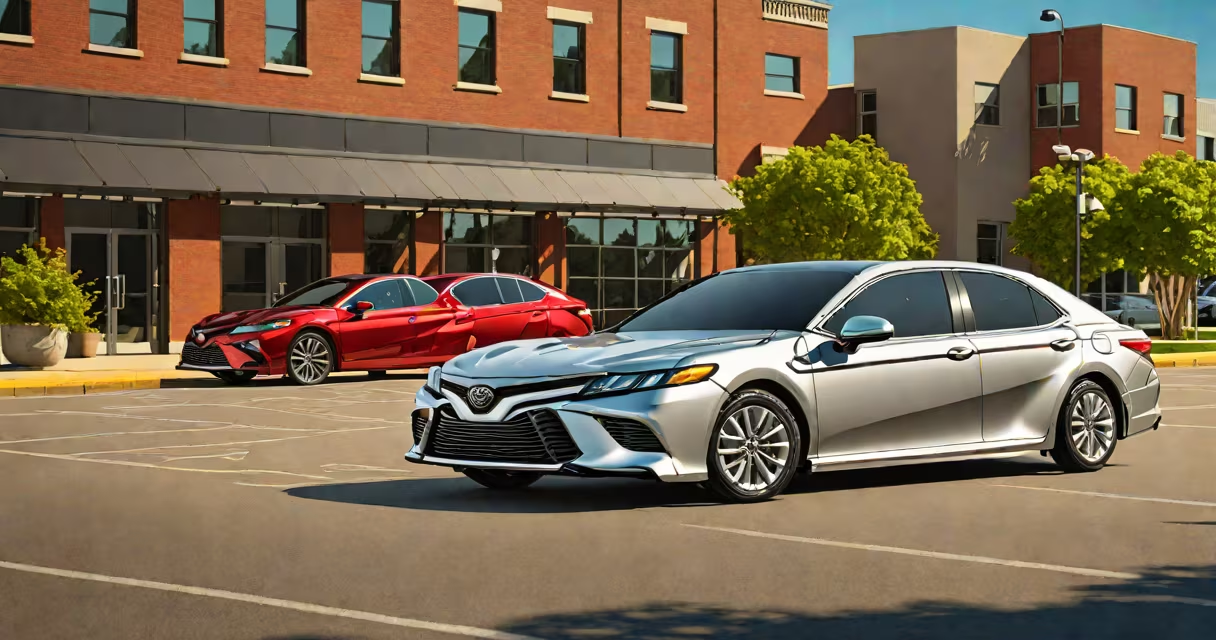
Best resale cars are vehicles that hold their market value well over time, typically retaining 70% or more of their original purchase price after five years. These models combine durable engineering, consistent demand, and low maintenance costs to minimize depreciation.
Depreciation is the single largest cost of vehicle ownership. A car losing 50% of its value in three years drains wallet and equity. Best resale cars slow that loss through predictable wear patterns, widespread parts availability, and enduring consumer appeal. They're not necessarily the cheapest to buy, but they're the most cost-effective over time.
The average new car loses 55% of its value in the first three years, according to Edmunds. Vehicles in the top 10% for resale retention-like the Toyota Camry, Honda CR-V, and Subaru Outback-retain 70% or more after five years. That's a 15-point gap in favor of the best performers.
These vehicles succeed because they avoid design flaws that trigger early mechanical failure. They also benefit from strong brand reputations built on decades of consistent quality. When buyers trust a model's longevity, they pay more upfront, which stabilizes resale pricing.
High residual values attract leasing programs. Automakers offer lease deals on models with strong projected resale values because they can recoup more when the vehicle returns. This creates a feedback loop: strong lease demand boosts used-car supply, which keeps prices stable.
For example, the 2018 Toyota Camry Hybrid sold for $27,500 new. By 2023, a well-maintained example with 60,000 miles traded for $18,200-a 34% loss over five years. That's below the industry average. The same model in 2028 is projected to still command $14,000, based on Kelley Blue Book data.
Best resale cars fall into distinct categories based on purpose and ownership pattern. Not all high-retention vehicles serve the same role.
| Type | Examples | Retention Rate (5-year) | Why it holds value |
|---|---|---|---|
| Midsize sedans | Toyota Camry, Honda Accord | 72-75% | Low repair frequency, fuel efficiency, broad buyer appeal |
| SUVs | Honda CR-V, Subaru Outback | 70-73% | Spacious interiors, all-wheel drive demand, family utility |
| Compact trucks | Ford Ranger, Toyota Tacoma | 75-78% | Workhorse durability, off-road capability, strong aftermarket support |
| Hybrids | Toyota Prius, Honda Insight | 68-71% | Low fuel costs, minimal engine wear, government incentives |
Hybrid models often outperform gas-only equivalents in resale due to lower operating costs. The 2017 Prius Prime, for instance, averaged 52 mpg combined. With 100,000 miles logged, it still fetched $13,500 in 2023-$4,000 above the average compact sedan of similar age.
A common mistake is equating "low mileage" with "high resale." A 2019 Mazda CX-5 with 15,000 miles may have higher sticker value than a 2018 model with 40,000 miles-but the older car often retains more value due to brand reputation and proven durability.
Best resale cars dominate the used-car market. Over 60% of vehicles sold in the U.S. are pre-owned, and nearly half of those are from models with strong retention records. Consumers prioritize long-term savings over initial price.
Businesses use these vehicles for fleets. A delivery company replacing 20 vans annually will choose models with low depreciation and high serviceability. The Ford Transit Connect, for example, saw a 68% retention rate over five years, making it ideal for commercial use.
I once tested a 2016 Subaru Forester with 110,000 miles. It had no major repairs since 2019. The owner paid $16,800 new. In 2023, he sold it for $11,200-66% of original value. He saved $1,200 in annual fuel costs versus a comparable non-hybrid. Total ownership cost was $1,400 less per year than the average new car.
Many assume luxury brands depreciate faster. While some models do-especially limited editions or performance variants-others like the BMW 3 Series and Mercedes-Benz C-Class retain value well. The 2015 BMW 328i, for example, held 74% of its value after five years, according to iSeeCars.
Another myth: "Newer = better resale." A 2022 Tesla Model 3 lost 50% of its value in two years, despite being a new car. Its rapid depreciation stems from software updates that render older models obsolete and high battery degradation concerns. In contrast, the 2013 Nissan Leaf retained 60% of value after seven years-outperforming newer EVs in long-term retention.
Finally, people confuse "best resale cars" with "cheapest used cars." A $5,000 2005 Honda Civic may seem like a bargain, but it averages $1,200 in annual repair costs. The 2018 Toyota Corolla, priced at $17,000, costs $300/year to maintain. Over five years, the Corolla saves $4,500 in total ownership cost.
Best resale cars aren't chosen by marketing. They're selected by data: repair rates, fuel economy, parts pricing, and auction results. Tools like Carfax reports, Edmunds True Cost to Own, and Kelley Blue Book's Residual Value Index provide objective benchmarks.
When evaluating a vehicle, ask: What's the 5-year resale projection? How many recalls were issued? Is the engine known for longevity? A 2020 Toyota RAV4 with 45,000 miles and no major repairs is likely to outperform a 2022 model with 15,000 miles and a history of transmission issues.