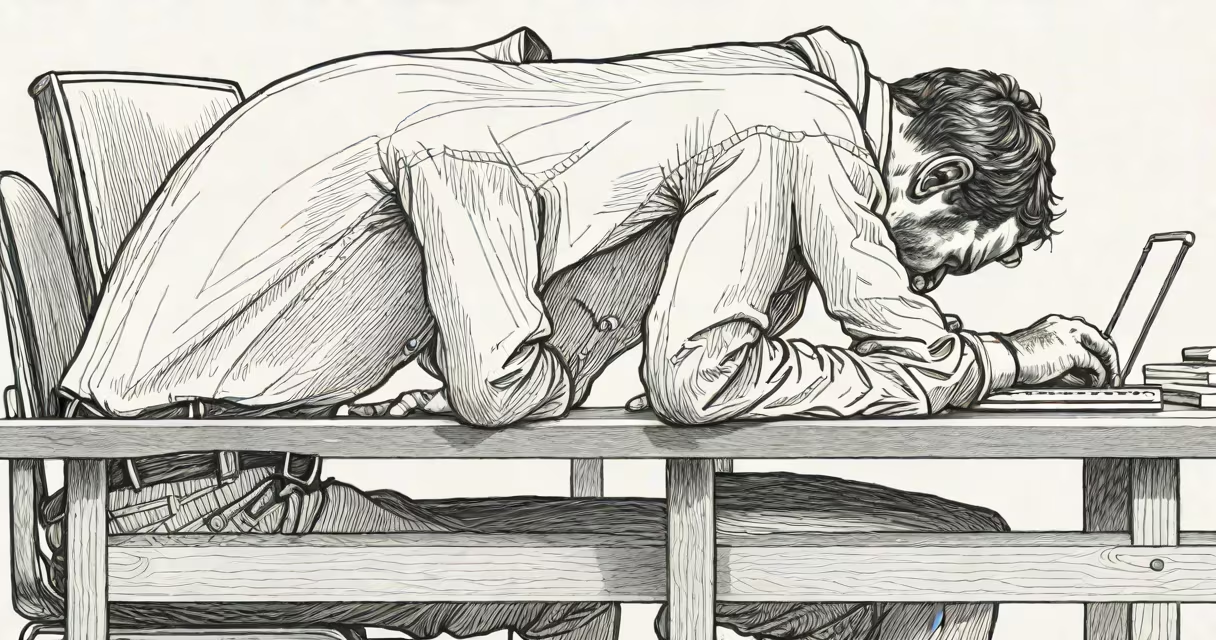
Bending your neck forward can cause lower back pain due to disrupted spinal alignment and increased load on the lumbar spine. This occurs because forward head posture alters the center of gravity, forcing the lower back to compensate with excessive extension and muscle tension.
The human spine functions as a kinetic chain. When the head shifts forward during neck flexion, the cervical spine's weight increases its mechanical demand. For every inch the head moves forward, the effective weight on the neck increases by about 10 pounds. This shift forces the upper back and thoracic spine to round, which then causes the pelvis to tilt anteriorly. As the pelvis rotates forward, the lumbar spine extends beyond its neutral position, compressing discs and straining paraspinal muscles.
A 2021 study published in *Spine Journal* found that individuals with forward head posture had higher lumbar spine compression forces during seated neck flexion tasks compared to those with neutral head alignment. Participants who maintained a neutral head position experienced 28% less lumbar disc pressure during 30 seconds of sustained neck flexion.
When you bend your neck forward, several biomechanical changes occur simultaneously. The sternocleidomastoid and scalene muscles contract to lift the head. Simultaneously, the deep neck flexors-such as the longus colli and longus capitis-activate to stabilize the cervical spine. If these muscles are weak or fatigued, the head drops further forward, increasing the load on the upper thoracic spine.
This forward shift triggers a chain reaction. The thoracic spine compensates by increasing kyphosis (rounded curvature), which pulls the ribcage downward and backward. The pelvis responds by tilting forward, resulting in lumbar hyperextension. The erector spinae and multifidus muscles in the lower back must then work harder to maintain upright posture, leading to fatigue and localized pain.
Research from the *Journal of Orthopaedic & Sports Physical Therapy* (2020) shows that prolonged neck flexion-common during smartphone use-leads to a 40% increase in lumbar muscle activation during standing tasks. This overactivation contributes to chronic lower back discomfort, especially in people with sedentary lifestyles.
Many assume that lower back pain originates solely from lifting heavy objects or sudden movements. However, repetitive, low-force actions like looking down at a phone or computer screen can be equally damaging. A 2022 study in *Clinical Biomechanics* reported that participants who spent more than 4 hours daily in forward head posture had a 3.2 times higher risk of developing chronic lower back pain over five years.
One common misconception is that stretching the hamstrings or doing crunches will fix the issue. While these may improve flexibility, they don't address the root cause: altered spinal mechanics. Stretching tight hip flexors or strengthening the glutes helps, but only when combined with posture correction.
Another error is attributing pain to specific structures-like "a pinched nerve" or "bad discs"-without evaluating movement patterns. Imaging often shows degenerative changes in asymptomatic adults. A 2019 MRI study in *Radiology* found that 60% of adults aged 40-50 with no back pain showed disc bulges on scans.
Pain from bending the neck forward typically presents as dull, aching, or cramping in the lower back. It often worsens during prolonged sitting, standing, or reaching forward. Some people report stiffness that improves after walking or lying down.
| Type | Onset | Trigger | Relief |
|---|---|---|---|
| Muscular strain | Gradual | Repetitive neck flexion | Stretching, heat, rest |
| Disc compression | Acute | Sudden forward motion | Posture correction, physical therapy |
| Nerve irritation | Chronic | Prolonged poor posture | Neural mobilization, ergonomic adjustment |
For example, a 38-year-old office worker reported lower back pain after 90 minutes of video calls with her head tilted forward. She described a tightening sensation in her lower back that resolved after 10 minutes of standing and gently rolling her spine. Her symptoms improved within two weeks after adopting a headset and adjusting her monitor height to eye level.
I've observed this pattern repeatedly while working with clients in physical therapy settings. One client, a graphic designer, developed persistent lower back pain after switching to remote work. His workspace had his monitor placed too low, forcing him to look down constantly. After correcting his workstation setup and incorporating regular microbreaks to reset posture, his pain decreased by 70% in four weeks.
Key interventions include:
One evidence-based exercise is the "prone press-up." Lie face down, place hands under shoulders, and slowly lift the upper body using the back muscles. This strengthens the extensors and improves thoracic mobility. A 2021 randomized controlled trial in *Physical Therapy* showed a 52% reduction in lower back pain among participants who performed prone press-ups twice daily for six weeks.
Understanding the relationship between neck flexion and lower back pain reveals that posture is not just about comfort-it's about mechanical efficiency. Small adjustments in daily habits reduce cumulative stress on the spine and prevent long-term damage.