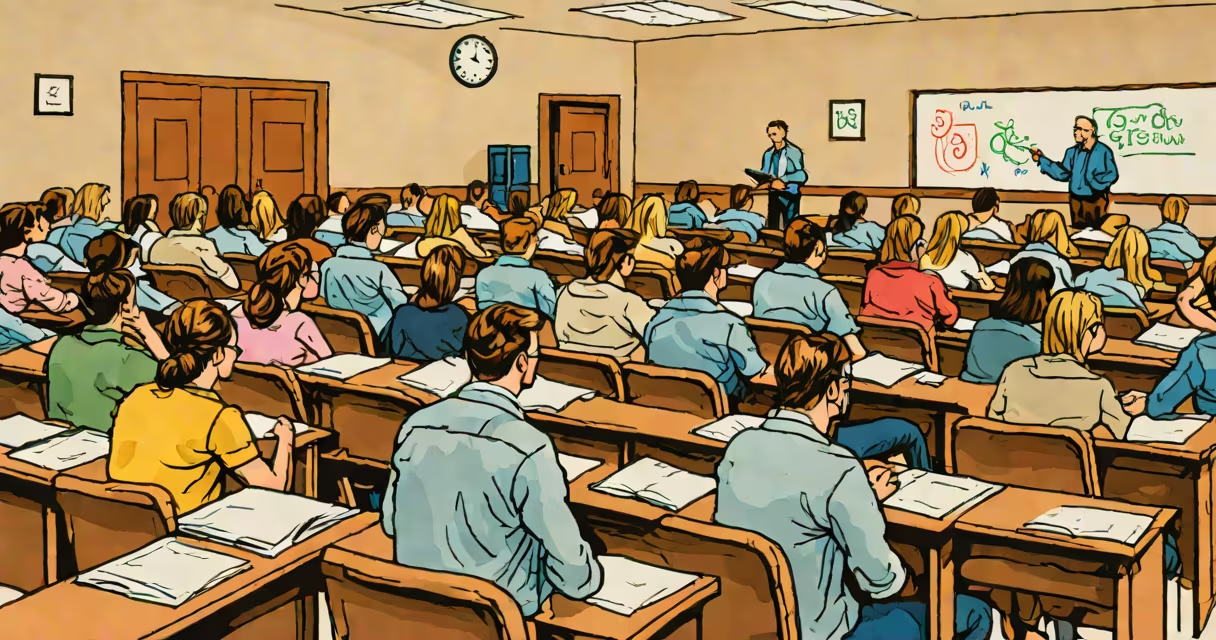
A bachelor's degree in psychology typically requires four years of full-time study, consisting of 120 credit hours across general education, core psychology courses, and electives. This standard timeline applies to most accredited institutions in the United States.
The structure of a bachelor's in psychology follows a consistent academic structure. Students begin with foundational courses such as Introduction to Psychology, Statistics for Behavioral Sciences, and Research Methods. These build toward advanced topics like Abnormal Psychology, Developmental Psychology, and Social Psychology. Most programs require a capstone project or senior thesis to demonstrate applied understanding.
According to the American Psychological Association (APA), the majority of undergraduate psychology programs are designed to be completed in eight semesters. The National Center for Education Statistics (NCES) reports that 68% of students who start a bachelor's degree in psychology finish within six years, indicating that while four years is standard, some take longer due to part-time enrollment or changing majors.
Full-time students typically take 15 credits per semester, totaling 30 credits per academic year. Over four years, this accumulates to 120 credits-the standard requirement for a bachelor's degree. Core courses include biological bases of behavior, psychological assessment, and ethics in research.
Students may choose between a Bachelor of Arts (BA) or Bachelor of Science (BS) in Psychology. The BA often emphasizes humanities and social sciences, allowing more flexibility in electives. The BS focuses on math, science, and research methods, preparing students for graduate school or lab-based roles. Both degrees follow the same four-year timeline.
Some institutions offer accelerated pathways. For example, California State University, Fullerton, allows students to complete their degree in three years through summer enrollment and course stacking. However, these options require careful planning and approval from an academic advisor.
| Program Type | Typical Duration | Credit Hours | Focus Areas |
|---|---|---|---|
| BA in Psychology | 4 years | 120 | Human behavior, social contexts, interdisciplinary electives |
| BS in Psychology | 4 years | 120 | Research methods, statistics, neuroscience, lab work |
| Accelerated Option | 3 years | 120 | Summer courses, compressed semesters, intensive scheduling |
Many assume that a bachelor's in psychology leads directly to clinical practice. That is incorrect. A bachelor's degree does not qualify someone to diagnose or treat mental health conditions. Clinical licensure requires a master's or doctoral degree in counseling, clinical psychology, or psychiatry.
Another misconception is that psychology degrees are less rigorous than STEM fields. The APA notes that psychology majors complete more quantitative coursework than 70% of non-science undergraduates. Courses in biopsychology and statistical analysis demand analytical reasoning comparable to engineering or computer science curricula.
I once observed a student in a research methods class struggle with SPSS software during a data analysis assignment. Their confusion stemmed not from lack of intelligence, but from underestimating the technical demands of behavioral science. The course required interpreting regression outputs and validating hypothesis tests-skills that mirror those taught in economics or public policy programs.
Graduates with a bachelor's in psychology pursue diverse careers. Common roles include mental health technician, human resources coordinator, case manager, or research assistant. According to the U.S. Bureau of Labor Statistics (BLS), employment for psychological assistants is projected to grow 10% from 2022 to 2032, faster than average.
For those seeking advanced roles, the next step is graduate school. A master's in counseling psychology typically takes two years. A PhD or PsyD in clinical psychology takes five to seven years. These programs include supervised clinical training and state licensing exams.
Those interested in research or academia often pursue a PhD. The National Science Foundation reports that 62% of psychology PhD recipients enter postdoctoral fellowships, often in universities or federal agencies like the National Institute of Mental Health (NIMH).
Unlike an aerospace bachelor degree, which focuses on engineering principles, aerodynamics, and flight systems, a psychology degree centers on human cognition, emotion, and behavior. Aerospace programs emphasize calculus, physics, and computer-aided design, while psychology programs stress qualitative analysis, ethical decision-making, and interpersonal communication.
Both degrees take four years and require 120 credits. But the skill sets differ. An aerospace student might spend 20 hours per week in labs building drone prototypes. A psychology student spends similar time conducting interviews, analyzing survey data, or observing behavioral patterns in controlled settings.
There is no shortcut to completing a bachelor's in psychology. Some online programs claim to deliver the degree in 18 months, but these are not regionally accredited and do not meet employer or graduate school standards. Accreditation ensures curriculum quality and transferability of credits.
When choosing a program, verify accreditation through the Higher Learning Commission (HLC) or regional accrediting bodies. Non-accredited degrees may not count toward graduate admissions or professional certification.
A bachelor's degree in psychology takes four years to complete when pursued full-time. This timeline includes 120 credit hours, core coursework in research and theory, and elective choices tailored to career interests. While some accelerated programs exist, they require intense scheduling and faculty approval. Understanding the actual duration and structure prevents misalignment between expectations and academic reality.